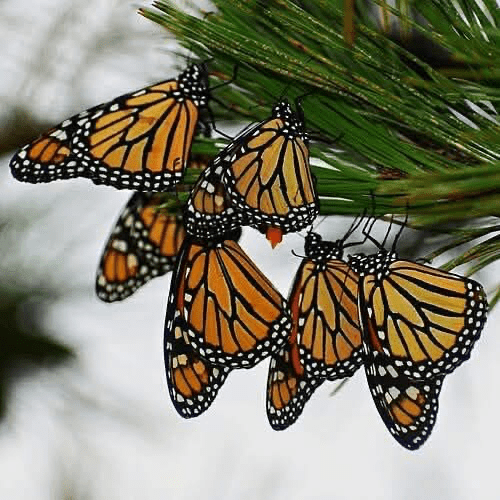
“For me it was one of the loveliest of the summer’s hours, and all the details will remain in my memory: that blue September sky, the sounds of wind in the spruces and surf on the rocks, the gulls busy with their foraging, alighting with deliberate grace, the distant views of Griffiths Head and Todd Point, today so clearly etched, though once half seen in swirling fog. But most of all I shall remember the Monarchs, that unhurried westward drift of one small winged form after another, each drawn by some invisible force. We talked a little about their migration, their life history. Did they return? We thought not; for most, at least, this was the closing journey of their lives.
But it occurred to me this afternoon, remembering, that it had been a happy spectacle, that we had felt no sadness when we spoke of the fact that there would no return. And rightly – for when any living thing has come to the end of its life cycle we accept that end as natural.
For the Monarch, that cycle is measured in a known span of months. For ourselves, the measure is something else, the span of which we cannot know. But the thought is the same: when that intangible cycle has run its course it is a natural and not unhappy thing that a life comes to its end.
That is what those brightly fluttering bits of life taught me this morning. I found a deep happiness in it – so, I hope, may you. Thank you for this morning.”
Rachel Carson, 1963 (last letter to a friend after a visit to the mouth of the Sheepscot river in Maine, USA), quoted in Wild Wisdom by Neil Douglas-Klotz
 King Edward Street Chapel