“”People must believe what they can, and those who believe more must not be hard upon those who believe less. I doubt if you would have believed it all yourself if you hadn’t seen some of it.”
George MacDonald, The Princess and the Goblin
Our long-standing beliefs – whether they be about the scientific nature of reality and temporal time or about our spirituality – have a tendency to become hidebound and static, comfortable and unchallenging. When we encounter situations and things that push at the boundaries of our comfortable enclave of belief, we have two options: we can totally ignore the challenge, safe in the belief that we are right, or we can enter into a temporary suspension of disbelief while we entertain the possibility that things are other than we have believed them to be. The suspension of disbelief is something that happens every time we attend a play or a movie: we lose all sense of separation between audience and performer as we see the story unfold before us, as we become immersed in events and protagonists. At the end of a moving performance, movie, or novel, we leave the world of that story and return to our own reality again.
The strongest challenges to belief are the things that we experience: experience is a great changer and shaper of belief because it gives us pragmatic knowledge that offers tangible and physical proof, even though its workings are often mysterious to us – we know what we experienced even though it may be “unbelievable.” This tells us that our perceptions are informing and changing belief. Sometimes the facts that we experience in our very body are so overwhelming that we have to enter into a suspension of disbelief, behaving “as it” they were true in order to accommodate the experience.
What is challenging your beliefs right now? Analyze the challenge using both sets of senses – physical and spiritual – to understand the experience.”
From The Celtic Spirit: Daily Meditations for the Turning Year by Caitlin Matthews
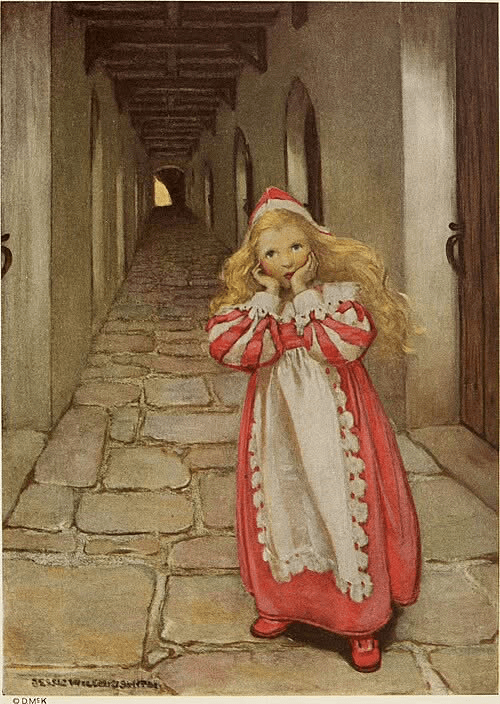
Image: Illustration from George MacDonald’s The Princess and the Goblin, 1920 edition, by Jessie Wilcox Smith
 King Edward Street Chapel