“Each individual experiences life in two worlds. There is the outer world and there is the inner world. One is the realm of the effect while the other is the realm of the cause. When we surrender to the sensory impressions of the outer world, then life is in the realm of effect, and we continually find ourselves in situations and predicaments that feel beyond our control. However, if we live from the inside out, we then live as masters. The interior, inner world, is the essence and the cause of the outer.” Rav DovBer Pinson
“To say that we are the presence of God in this world is not a metaphor. We are the face of God in this world, and God’s voice and hands. God changes outcomes in this world only as we change them. God is not an independent agent, in other words. God is dependent upon us. The active agency of the divine life emerges through our choices and actions.” Galen Guengerich
Today is the feast day of Irish Saint Gobnait. Her legend tells that she was born in County Clare in the fifth or sixth century, and went to study the monastic life on Inisheer in the Aran Islands. Here an angel appeared and told her that this was “not the place of her resurrection” and that she should look for a place where she would find nine white deer grazing. She travelled around Ireland and eventually found the deer at Ballyvourney in County Cork, where she founded a monastery, kept bees and cared for the sick, using the healing properties of honey.
St. Gobnait and the Place of Her Resurrection by Christine Valters Paintner,
“On the tiny limestone island an angel buzzes to Gobnait in a dream, disrupts her plans, sends her in search of nine white deer.
She wanders for miles across sea and land until at last they appear and rather than running toward them
she falls gently to wet ground, sits in silence as light crawls across sky, lets their long legs approach and their soft, curious noses surround her.
Breathing slowly, she slides back onto grass and clover and knows nothing surpasses this moment, a heaven of hooves and dew.
Is there a place for each of us, where we no longer yearn to be elsewhere? Where our work is to simply soften, wait, and pay close attention?
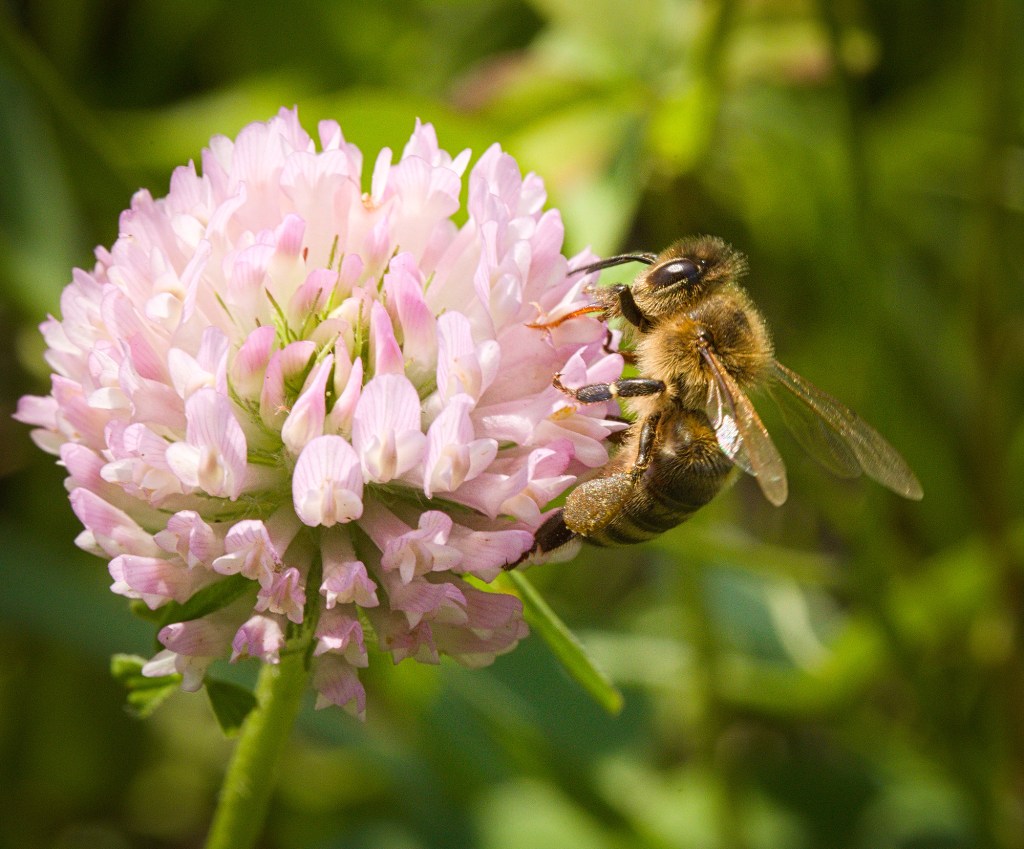
She smiles as bees gather eagerly around her too, wings humming softly as they collect essence of wildflowers, transmuting labor into gold.”
Returning Home by Kashmiri mystic and poet Lalla (1320 – 1392),
“I rushed here and there, longing, seeking and searching, day and night. At last I returned home and found what I was looking for—the guru inside! Like grasping a star, I held on. Controlling my breath, like fanning a flame with a bellows, my heart-lamp came alight. Breathing on that light, the chaff that separates me from my true nature scattered. Now even in darkness that light holds me tight. Go ahead, rule a kingdom—no rest there. Give it away—your heart’s still troubled. Only free your soul from desire— the soul that never dies! Better yet, while alive, die. Then you’ll know the truth. Your reputation is like water carried in a basket. If you can hold the wind in your hand or leash an elephant with your hair— sure, then you can hold onto it!”
An Invitation to Give Up Being Advanced by Fred Lamotte,
“Spiritual egos make a distinction between “beginner’s techniques” and “advanced techniques.” Their intellect wants something difficult to do, a sense of accomplishment. That is why so many new age teachers speak of their spiritual “work.” Do they ever speak of their spiritual “play”?
Ease is the cure for dis-ease. The deepest, most healing spiritual practice, we ease into. In fact, we do not practice. We let go of practice. Only the absolute innocence of the beginner, starting over again each moment, can experience the end of the journey, the goal. For the goal is always already attained by Grace.
The goal is never an achievement done by “advanced” practice, but the dissolution of the do-er. It is known by un-knowing and done by un-doing. This can only happen to the effortless. The most powerful meditation is the simplest, the most natural.
When you really look at people who carry a bag of “advanced” techniques, you often see a weariness behind the stiff mask of their perpetual smile. Or they look tentative, because they are always taking the next step, and never completely here. Only the beginner dwells in eternal freshness, the greening power of the heart. The beginner is never advanced because she is present.
In the deepest and most natural meditation, you never have to leave your body. Every atom of your body is already woven out of swirling stars, and rooted in mycelia for a hundred subterranean miles in every direction. No wind can uproot the beginner. No wound can puncture the intergalactic stillness in the Beginner’s core…
When you meditate, be a beginner. Always feel the freshness of the first day of creation, “in the beginning,” when God and his breath, the Goddess, create the universe again. Now is the beginning. Now is the end of time. How could now be advanced?”
From Honoring the Body by Christine Valters-Paintner,
“Chronic illness asks you to navigate between worlds, the vertical land of the well, or “temporarily able-bodied” as those in the disability community say, and the horizontal world where most hours are spent in bed. This forced convalescence offers a new perspective on the world of rushing and doing. Each flare of my illness [rheumatoid arthritis] became another initiation into the resistance of capitalist expectations of relentless productivity, which demanded I value my life in terms of output.
It has been 30 years since that initial diagnosis. The medications to treat my illness have greatly improved and I count it as a profound grace that I have not been ravaged by it the way my mother was.
The true grace over time has been deepened intimacy with my body, the long hours spent listening to her call me like a lover, asking me to live as a witness to another way of being, one that values slowness, spaciousness, humility, vulnerability. One that knows Sabbath as a stance of opposition to the forces that train us to deplete ourselves. My body’s vulnerability has informed everything I teach and write about contemplative practice. I believe that a slow, intentional life is a radical act of witness to another way of being. I have learned to honor limits and find beauty in that space of surrender and yielding to another way.
My story is not a one-way hero’s journey. I have not overcome or done battle; I don’t want to be anybody’s inspiration. Stories that give the impression that one can achieve victory over the body’s vulnerabilities do a great disservice to the collective imagination by pushing away the discomfort of grief. I want my story to reveal that tenderness and surrender instead of fortitude and domination are signs of strength. I want my story to say that yielding to my body’s needs rather than forcing myself onward is a sign of wisdom.
In the monastic tradition, memento mori – remembering that you will one day die – is considered an essential daily practice to help us to remember to cherish life. I am reminded moment by moment by my body that everything is gift, nothing is to be taken for granted. This window of feeling well will not last forever. Similarly, this physical pain will also subside eventually. And we will all one day cross over the threshold and leave this world. Joy and sorrow are sisters; each carves out room in us to experience the other more deeply.
On my good days, I still sometimes do a lot, sometimes beyond my body’s capacity, and I feel the impact. Productivity is seductive. I still have a lot of bad days where most of my hours are spent horizontal despite how well I try to take care of myself. The truth involves very little linear achievement and a lot more mess.
All these years after that first diagnosis, I keep discovering new layers of how my primary vocation is to relish this vessel of flesh, blood, and bone, and to make time for the always erupting griefs. I’m called to serve from a place of rest and abundance rather than exhaustion and scarcity, and to treasure myself apart from all the things I can do.”
“To me, Imbolc is such a powerful mystery of time because it is like the space between thoughts. If there’s nothing I need to think about right now, then I just stop thinking. Start listening. Listen to the music of awakening seeds, the whisper of creation bubbling out of silence all around me. The wordless breath of the Creator is a subtle thunder, more healing than any thought I could possibly think in this moment.” Fred LaMotte



 King Edward Street Chapel