“I find that quakerism and research science fit together very, very well. In quakerism you’re expected to develop your own understanding of god from your experience in the world. There isn’t a creed, there isn’t a dogma. There’s an understanding but nothing as formal as a dogma or creed and this idea that you develop your own understanding also means that you keep redeveloping your understanding as you get more experience, and it seems to me that’s very like what goes on in “the scientific method.” You have a model, of a star, its an understanding, and you develop that model in the light of experiments and observations, and so in both you’re expected to evolve your thinking. Nothing is static, nothing is final, everything is held provisionally.”
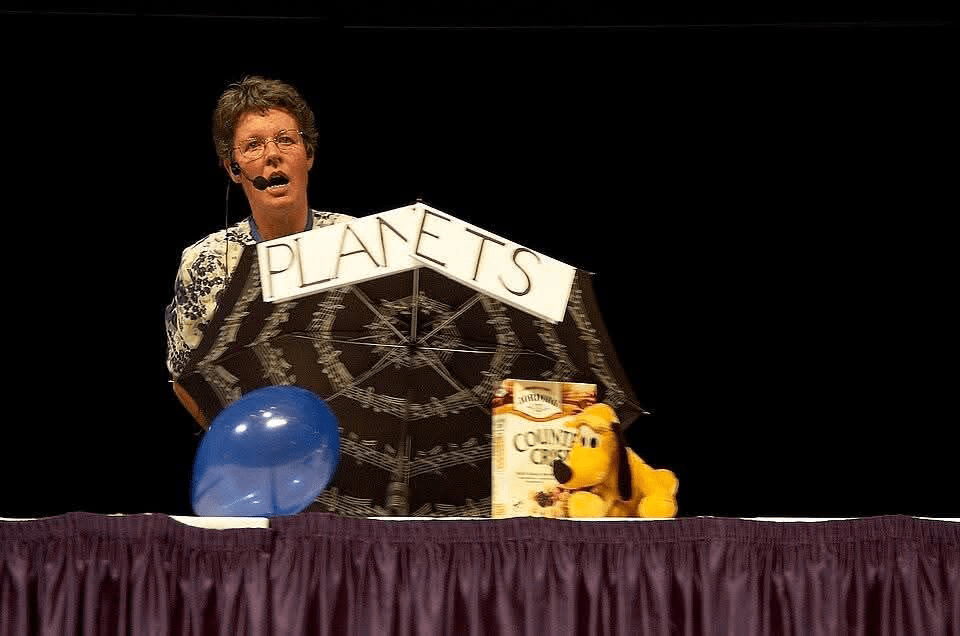
Jocelyn Bell Burnell, astrophysicist, born on this day in 1943 – pictured at the International Astronomical Union General Assembly, 2006
“I have hoped as many hopes and dreamed so many dreams, seen them swept aside by weather, and blown away by men, washed away in my own mistakes, that — I use to wonder if it wouldn’t be better just to haul off and quit hoping. Just protect my own inner brain, my own mind and heart, by drawing it up into a hard knot, and not having any more hopes or dreams at all. Pull in my feelings, and call back all of my sentiments — and not let any earthly event move me in either direction, either cause me to hate, to fear, to love, to care, to take sides, to argue the matter at all — and, yet … there are certain good times, and pleasures that I never can forget, no matter how much I want to, because the pleasures, and the displeasures, the good times and the bad, are really all there is to me.
And these pleasures that you cannot ever forget are the yeast that always starts working in your mind again, and it gets in your thoughts again, and in your eyes again, and then, all at once, no matter what has happened to you, you are building a brand new world again, based and built on the mistakes, the wreck, the hard luck and trouble of the old one.”
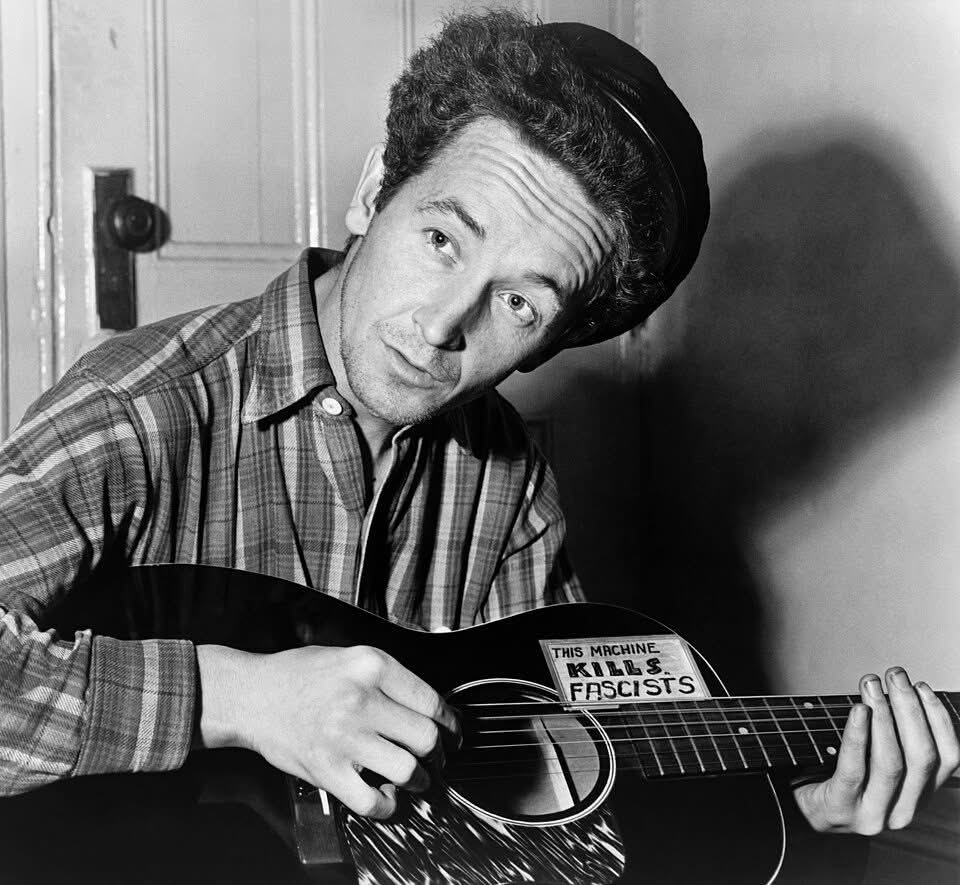
Woody Guthrie (1912 – 1967), folk singer-songwriter, born on this day
“Willa Cather’s poem, “I Sought the Wood in Summer,” tells of its protagonist despairing during the hot months. The trees tremble beautifully in the light, the daffodils glisten, yet every breath Beauty “gives the vagrant summer but swifter woos her death.” It’s not until the poet returns to the wood in winter that she sees the power of beauty, its ability to renew itself continually.
Amid the season’s heat and light, it’s easy sometimes to forget there has ever been or will be anything else. But we cannot judge a thing by the climate of one day, or even one month. It’s not until you spend years in a place that you know its true strengths and weaknesses, the range of miracles.”
From Earth Bound: Daily Meditations For All Seasons by Brian Nelson
“We need the tonic of wildness…At the same time that we are earnest to explore and learn all things, we require that all things be mysterious and unexplorable, that land and sea be indefinitely wild, unsurveyed and unfathomed by us because unfathomable. We can never have enough of nature.”
Henry David Thoreau (1817 – 1862), transcendentalist, writer, naturalist, born on this day
“The creation and the Creator are not two. Just as all golden jewelry is nothing but gold, just as all earthen pots are essentially nothing but clay, just as every wave is basically water, so too it is the Creator that has become this world.”
“I stand on the edge of myself and wonder where is home? Oh, where is the place where beauty will last? When will I be safe? And where?
My tourist heart is wearing me out. I am so tired of seeking for treasures that tarnish. How much longer, Lord? Oh, which way is home? My luggage is heavy. It is weighing me down. I am hungry for the holy ground of home.
Then suddenly, overpowering me with the truth, A voice within me gentles me, and says:
There is a power in you, a truth in you That has not yet been tapped. You are blinded with a blindness that is deep For you’ve not loved the pilgrim in you yet.
There is a road that runs straight through your heart. Walk on it.
To be a pilgrim means to be on the move, slowly, To notice your luggage becoming lighter To be seeking for treasures that do not rust To be comfortable with your heart’s questions To be moving toward the holy ground of home With empty hands and bare feet.
And yet, you cannot reach that home Until you’ve loved the pilgrim in you. One must be comfortable with pilgrimhood Before one’s feet can touch the homeland.
Do you want to go home? There’s a road that runs straight through your heart. Walk on it.”
Tourist or Pilgrim? by Sister Macrina Wiederkehr (1939 – 2020)
“When we look deeply into others, we’re looking deeply into ourselves at the same time. If we think the other person is someone other than us, that their success or failure has nothing to do with us, then we have not been successful in our looking deeply. The happiness of that person is linked to our own happiness. If we’re not happy, the other person can’t be happy, and our larger community won’t be happy.”
“There was an Old Woman lived under the hill And if she’s not gone, she lives there still – traditional British rhyme
Feminine and masculine are the left and right hands of God. We have only recently begun to remember the divine feminine and to respect her again, but she has never been far from us. Earth herself reminds us of the living presence of the feminine principle as she unfolds her many faces through the cycle of the year. The Old Woman who lives under the hill is the oldest grandmother of us all: our very substance derives from her, and as we trace her many aspects through the seasons, we appreciate the different gifts with which we are endowed.
As a young girl in spring, she is innocent; playful and delightful, she responds to beauty with joy. When our hearts are in springtime mode, we are filled with clarity and truth, in touch with our own integrity. In May-time, when blossom’s heady scent of desire is in the air, she reaches the borders of womanhood and looks with desire upon the beloved of her heart, rejoicing in the song of summer’s freedom. When our hearts are in summer mode, we have power and self-confidence.
In autumn, she becomes mother, fierce protector of all that she loves. In autumn, we reflect this face as our creative vision is fulfilled. When winter comes, she strips bare the bough, clarifying each soul. But many do not choose to know her now, for she grows thin and gray. Yet she is ever stronger, as ice and snow cover her with a new mantle.
Those who fear the Old Woman’s features never kiss her or call upon her wisdom. But she welcomes all, calling us to look again and find in ourselves the reflection of her wisdom. She calls us to realize that she is in every part of the universe, that the earth is but our most immediate mirror of her features. Her truth, beauty, compassion, and wisdom are in every place, in every face.”
From The Celtic Spirit: Daily Meditations for the Turning Year by Caitlin Matthews
“I used to think I was the strangest person in the world but then I thought there are so many people in the world, there must be someone just like me who feels bizarre and flawed in the same ways I do. I would imagine her, and imagine that she must be out there thinking of me too. Well, I hope that if you are out there and read this and know that, yes, it’s true I’m here, and I’m just as strange as you.”
Frida Kahlo (1907 – 1954), painter, born on this day