“Some say the world will end in fire, Some say in ice. From what I’ve tasted of desire I hold with those who favor fire. But if it had to perish twice, I think I know enough of hate To say that for destruction ice Is also great And would suffice.”
Robert Frost (1874 – 1963), poet, born on this day
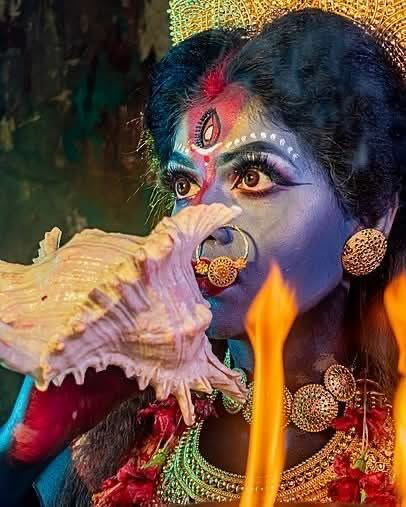
“There is another game of hide-and-seek that the Great Mother plays. This is more like a fairy story. She hides sometimes in other people. She hides in anything. Any day you might see Her eyes, just looking into mother’s, or playing with a kitten, or picking up a bird that had fallen from its nest. Under all these forms you may find God playing at hide-and-seek! When there is something to do for someone–Kali is calling us to play. We lave that play. She Herself said once (She was hiding in someone, and He said it for Her). “Inasmuch as ye did it unto one of the least of these, My little ones, ye did it unto Me.” Is not that like a fairy story! And what funny places She, the Great Mother, can hide in! Another time She said ” Lift the stone, and thou shalt find Me. Cleave the wood, and there am I!” Did you ever lift a stone or break a piece of wood to see what was inside? Did you ever think that was God–at the heart of things? How beautifully Kali plays! You might find Her anywhere!”
From The Story of Kali by Sister Nivedita (born Margaret Noble), first western woman received into an Indian monastic order (by Swami Vivekananda), on this day in 1898
International Day for the Right to the Truth concerning Gross Human Rights Violations and for the Dignity of Victims (created in honour of Archbishop Oscar Romero, murdered on this day in 1980)
““You can tell the people that if they proceed in killing me, that I forgive and bless those who do it. Hopefully, they will realize that they are wasting their time. A bishop will die, but the church of God, which is the people will never perish.
The church would betray its own love for God and its fidelity to the gospel if it stopped being a defender of the rights of the poor, or a humanizer of every legitimate struggle to achieve a more just society … that prepares the way for the true reign of God in history.
When the church hears the cry of the oppressed it cannot but denounce the social structures that give rise to and perpetuate the misery from which the cry arises.”
Archbishop Oscar Romero
Romero predicted his own murder, for this speech was given shortly before he was shot down while celebrating the liturgy. Around the same time, he wrote the American president begging him to cease providing money for the Salvadorian military, which was making war on the country’s citizens. He stood for those with very little voice. He understood the church “is the people,” more than it is structure or hierarchy. He walked his talk and paid the price of martyrdom. Do we continue to take courage from his example?”
“When I lived under the black oaks I felt I was made of leaves. When I lived by Little Sister Pond, I dreamed I was the feather of the blue heron left on the shore; I was the pond lily, my root delicate as an artery, my face like a star, my happiness brimming. Later I was the footsteps that follow the sea. I knew the tides, I knew the ingredients of the wrack. I knew the elder, the red-throated loon with his uplifted beak and his smart eye. I felt I was the tip of the wave, the pearl of water on the eider’s glossy back. No, there’s no escaping, nor would I want to escape this outgo, this foot-loosening, this solution to gravity and a single shape. Now I am here, later I will be there. I will be that small cloud, staring down at the water, the one that stalls, that lifts its white legs, that looks like a lamb.”
International Day for the Elimination of Racial Discrimination and UNESCO World Poetry Day
“My blood swims in every water way, every tributary between here and the Delta Layers of my lineage are pounded into hot red clay, tint the ring of trees, are hewn across the scarred fields of southern farms. From the striving metal of plows and guns, shifting whorls of fingerprint echo across state lines on train car railings and travelling shoes, sacks and cases clutched in hands, rare and luminous keys and pens; I know our blood runs over and under the dirt; that our ghosts get louder as you follow down the Ilinois Central Line, and along its connections… from Mississippi and Tennessee tracking north and leaning on the sun
My family is not a tree, but a river Four streams in before our story gets lost in the din of the Mighty Mississippi, on to ancestor oceans, impossibly vast.
My great, great, great-grandmothers are likely Mollie Missouri Malvina Adeline … Features inked out by the Blackness of their living Details erased by the whiteness of record. I know you are written somewhere: name and story: planters’ ledger colonizer’s census family bible newspaper or grave … I need to know and speak your names.”
A Black Daughter Speaks of Rivers by Atena O. Danner, Unitarian-Universalist minister
“What struck me most was the silence. It was a great silence, unlike any I have encountered on Earth, so vast and deep that I began to hear my own body: my heart beating, my blood vessels pulsing, even the rustle of my muscles moving over each other seemed audible. There were more stars in the sky than I had expected. The sky was deep black, yet at the same time bright with sunlight…
The Earth was small, light blue, and so touchingly alone, our home that must be defended like a holy relic. The Earth was absolutely round. I believe I never knew what the word round meant until I saw Earth from space.”
Alexei Leonov, first person to conduct a spacewalk, on this day in 1965
“Images of leprechauns, magical creatures who live in the earth and play tricks on humans, are a staple of Saint Patrick’s Day. Yet like many legends, the leprechauns may have their basis in fact. In the so-called Dark Ages, it is believed that Lapps sailed across the sea from Lapland to make their homes on the warmer Emerald Isle. As they did in their native land, the Lapps – who were markedly shorter than the Irish – hollowed out homes under the sod. The ways of the Lapps were mysterious to the natives and may have given rise to the legends of leprechauns. The ways of others often seem incomprehensible to us. Today, learn more about a tradition that seems alien to you. Perhaps you’ll find magic in it.”
From Earth Bound: Daily Meditations For All Seasons by Brian Nelson