Thought for the day, Friday 20th December

International Human Solidarity Day

“All of us have monarchs and sages for kinsmen; nay, angels and archangels for cousins; since in antediluvian days, the sons of God did verily wed with our mothers, the irresistible daughters of Eve. All generations are blended: and heaven and earth of one kin: the hierarchies of seraphs in the uttermost skies; the thrones and principalities in the zodiac; the shades that roam throughout space; the nations and families flocks and folds of the earth; one and all – brothers in essence – oh, be we then brothers indeed! All things form but one whole.”

Herman Melville (1819 – 1891), writer, quoted in Fragments of Holiness for Daily Reflection

Thought for the day, Tuesday 17th December

“How mistaken are those people who seek happiness outside of themselves, in foreign lands and journeys, in riches and glory, in great possessions and pleasures, in diversions and vain things, which have a bitter end! It is the same thing to construct the tower of happiness outside of ourselves as it is to build a house in a place that is consistently shaken by earthquakes. Happiness is found within ourselves, and blessed is the man who has understood this.”

St. Nektarios of Aegina (1846 – 1920)

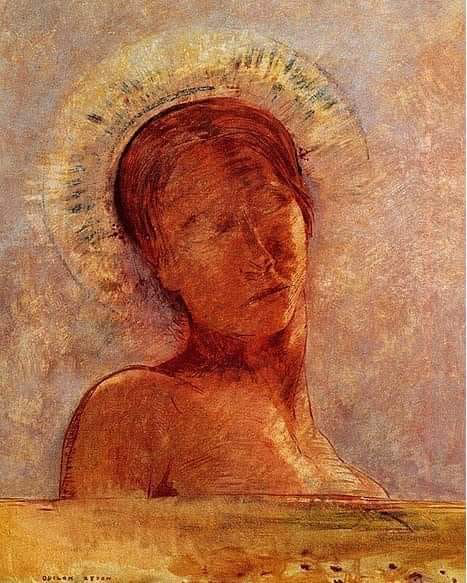
Art by Odilon Redon, 1899

Thought for the day, Monday 16th December

“”All things love each other. All nature is oriented toward a thou. All beings that are love are in communion with each other.. All beings love each other or feed each other, and are all united in a gigantic process of birth and growth and reproduction and death… All nature is in close touch and interwoven. All nature is in constant embrace. The wind which caresses me and the sun which kisses me, the air which I inhale, and the fish which swims in the water, the distant star and I who behold it: we are all in close touch with one another.”
Ernesto Cardenal

Life… is a place of no-survival, for we all die and all beings die. The question is: Is it also a place of life-before-death and love-before-death? How much love is truly shared? And how much are we part of that love?”

From Christian Mystics by Matthew Fox

Thought for the day, Thursday 12th December

“Nothing ceases to exist – there is no example of this in nature.. .There is an entire mass of things that cannot rationally explained. There are newborn thoughts that have not yet found form. How foolish to deny the existence of the soul. After all, that a life has begun, that cannot be denied. It is necessary to believe in immortality, insofar as it can be demonstrated that the atoms of life or the spirit of life must continue to exist after the body’s death. But of what does it exist, this characteristic of holding a body together, causing matter to change and develop, this spirit of life? I felt it as a sensual delight that I should become one with – become this earth which is forever radiated by the sun in such a constant ferment and which lives – lives – and which will grow plants from my decaying body – trees and flowers – and the sun will warm them and I will exist in them – and nothing will perish – and that is eternity.”

Edvard Munch (1863 – 1944), painter, born on this day

Wednesday 11th December

International Mountain Day

“Well, I have discovered my mountain – its weathers, its airs and lights, its singing burns, its haunted dells, its pinnacles and tarns, its birds and flowers, its snows, its long blue distances. Year by year, I have grown in familiarity with them all.

But if the whole truth of them is to be told as I have found it, I too am involved. I have been the instrument of my own discovering; and to govern the stops of the instrument needs learning too. Thus the senses must be trained and disciplined, the eye to look, the ear to listen, the body must be trained to move with the right harmonies. I can teach my body many skills by which to learn the nature of the mountain. One of the most compelling is quiescence.

A 4 am start leaves plenty of time for these hours of quiescence, and perhaps of sleep, on the summits. One’s body is limber with the sustained rhythm of mounting, and relaxed in the ease that follows the eating of food. One is as tranquil as the stones, rooted far down in their immobility. The soil is no more a part of the earth. If sleep comes at such a moment, its coming is a movement as natural as day. And after – ceasing to be a stone, to be the soil of the earth, opening eyes that have human cognisance behind them upon what one has been so profoundly a part of. That is all.
One has been in.”

From The Living Mountain by Nan Shepherd, 1947